
- TOP
- NEWS & TOPICS
- World's First: Capturing Sounds Reaching…
2026.4.30
World's First: Capturing Sounds Reaching the "Edge of Space" from the Ground - Direct Observation of Infrasound Above 100 km Altitude Achieved Using the Commercial Rocket MOMO3 -
World's First: Capturing Sounds Reaching the "Edge of Space" from the Ground - Direct Observation of Infrasound Above 100 km Altitude Achieved Using the Commercial Rocket MOMO3 -
Key Points
- A pressure sensor mounted on the commercial small rocket MOMO3 detected infrasound (low-frequency sound waves) generated by a ground-based sound source (fireworks) at an altitude of over 100 km, marking the world's first direct observation of its kind.
- Infrasound signals were also observed in the mesosphere (approximately 50-76 km altitude), where the atmosphere is extremely rarefied, and in the lower thermosphere (approximately 106-109 km altitude). The observed signals were in good agreement with theoretical predictions obtained from atmospheric sound propagation simulations.
- Infrasound generated by events such as volcanic eruptions, tsunamis, and meteor explosions is an important target for disaster prevention and environmental monitoring. These results demonstrate the potential of this technique to provide a new observational platform for future disaster monitoring and high-altitude atmospheric observations.
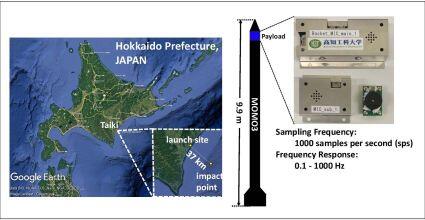
▲ The commercial rocket MOMO3, launched in Taiki, Hokkaido, Japan, in May 2019 (upper left), carried the broadband over-pressure sensor INF03D (upper right). The sensor achieved the world's first direct observation of infrasound at an altitude exceeding 100 km.
Research Summary
A research team from Chitose Institute of Science and Technology and Kochi University of Technology analyzed pressure data collected by the INF03D sensor aboard the commercial small rocket MOMO3, launched by Interstellar Technologies Inc. from Taiki, Hokkaido, in May 2019. The team successfully detected infrasound¹ generated by fireworks launched from the ground at altitudes ranging from the mesosphere to the lower thermosphere². This marks the world's first direct observation demonstrating that ground-generated infrasound can propagate to altitudes exceeding 100 km, based on measurements obtained by a rocket-borne sensor.
The pressure data obtained during the MOMO3 experiment, conducted by Professor Masa-yuki Yamamoto of Kochi University of Technology and his colleagues, were analyzed primarily by Assistant Professor Hiroaki Saito of Chitose Institute of Science and Technology, who also serves as a Visiting Lecturer at Kochi University of Technology. The INF03D broadband differential pressure sensor installed on MOMO3 is capable of detecting signals ranging from extremely low-frequency infrasound to frequencies approaching the audible range. Fireworks launched from the ground were used as a controlled infrasound source because their launch times were precisely known, allowing the signals to be distinguished from other natural sources such as thunder.
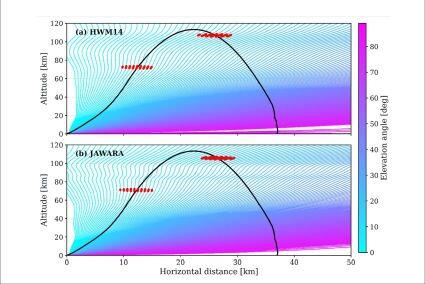
The analysis identified four distinct pressure fluctuations while the rocket was ascending at altitudes of approximately 50-76 km, and weaker but consistent signals during its descent at approximately 106-109 km. The observed arrival times were in good agreement with predictions obtained from three-dimensional ray tracing*³, while the measured amplitudes were also consistent with attenuation models that account for both geometric spreading and frequency-dependent atmospheric absorption.
Infrasound is low-frequency acoustic energy generated by phenomena such as volcanic eruptions, explosions, tsunamis, and rocket launches, and is an important target for disaster prevention and environmental monitoring. This study provides the first direct observational evidence of how disaster-generated infrasound propagates through the upper atmosphere and demonstrates the potential of this approach as a new observational platform for future disaster monitoring and high-altitude atmospheric diagnostics.
Comment from Prof. Masa-yuki YAMAMOTO
This study was conducted using the commercial rocket MOMO3, which was launched from Taiki, Hokkaido, on May 4, 2019, just four days after the beginning of the Reiwa era in Japan.
Although the experiment was carefully planned and carried out, verifying the propagation of infrasound using a small fireworks source that generated only a very weak acoustic pressure was highly challenging, and it was not possible to obtain definitive confirmation immediately after the experiment.
Subsequently, through detailed calculations of the acoustic wave propagation process performed by Lecturer Hiroaki Saito of the current Chitose Institute of Science and Technology (who was an Assistant Professor at Kochi University of Technology at the time of the experiment), we were able to obtain evidence that the sound generated by the fireworks reached from the mesosphere to the lower thermosphere.
We would like to express our sincere gratitude to our two co-authors and all members of our laboratory who supported this research from the beginning, Saya Co., Ltd., which developed the onboard instruments, the members of Interstellar Technologies Inc. at the time who successfully launched MOMO3 and created opportunities for private-sector space experiments, as well as the Taiki Town Office and all others who contributed to this achievement.
Glossary
*1) Infrasound
Infrasound refers to extremely low-frequency sound waves below 20 Hz, which are difficult for humans to hear. It is generated by phenomena such as volcanic eruptions, explosions, atmospheric disturbances associated with tsunamis, and rocket launches, and can propagate over long distances.
*2) From the Mesosphere to the Lower Thermosphere
This refers to the high-altitude region of the atmosphere extending from approximately 50 km above the Earth's surface to around 100 km altitude. This region is difficult to observe directly because balloons cannot easily reach altitudes above approximately 55 km.
*3) Ray Tracing
A computational method used to calculate the propagation paths of sound waves and predict where they will arrive based on atmospheric temperature and wind distributions.
Published Paper
Title:
First Detection of Firework-Generated Infrasound in the Upper Mesosphere-Lower Thermosphere With a Rocket-Borne Sensor: Results From the MOMO3 Sounding Rocket Experiment
Authors:
Hiroaki Saito, Yusuke Yasukouchi, Takamasa Hiratsuka, Masa-yuki Yamamoto
Journal:
Journal of Geophysical Research: Atmospheres
Publication Information:
Volume 131, Issue 8, April 2026
DOI:
https://agupubs.onlinelibrary.wiley.com/doi/10.1029/2025JD045676