
- TOP
- NEWS & TOPICS
- Converting Nitrate Pollution into Green …
2026.8. 4Research
Converting Nitrate Pollution into Green Ammonia: A New Self-Adaptive Catalyst Achieves Water Purification and Resource Recovery
Converting Nitrate Pollution into Green Ammonia: A New Self-Adaptive Catalyst Achieves Water Purification and Resource Recovery
A research group comprising Ms. Chunyu Yuan, a third-year doctoral student at Kochi University of Technology, Professor Akitaka Ito and Professor Takeshi Fujita of the School of Engineering Science, together with Associate Professor Tatsuhiko Ohto of Nagoya University, has developed a self-adaptive copper-cobalt catalyst (Figure 1(a)) that enables highly efficient and stable ammonia synthesis through electrochemical nitrate reduction (NO₃RR).
Electrocatalysts generally suffer from structural degradation or changes during operation, making it difficult to maintain high catalytic performance. By combining advanced operando and quasi-operando spectroscopic analyses with density functional theory (DFT) calculations, the research team became the first in the world to elucidate the detailed mechanism of adaptive catalyst reconstruction, in which the catalyst dynamically evolves into its most active state during electrochemical nitrate reduction.
The newly developed technology is expected to serve as a "two-in-one" clean technology by simultaneously removing harmful nitrate contaminants from agricultural and industrial wastewater while recovering green ammonia, a key carbon-free resource for a decarbonized society.
The research was published online in the international journal Advanced Science on July 13, 2026.
Highlights
- Developed a self-adaptive catalyst that dynamically reconstructs into its most active state by forming hydroxyl-rich Cu-OH active sites during electrochemical nitrate reduction.
- Revealed the cooperative catalytic mechanism between copper and cobalt, in which hydrogen spillover from amorphous cobalt oxide accelerates ammonia production.
- Simultaneously achieved water purification through nitrate removal and resource recovery through green ammonia synthesis under ambient conditions.
- Because the catalyst can be synthesized entirely at room temperature and atmospheric pressure, it is well suited for large-scale production and is expected to be applicable to other electrochemical technologies, including carbon dioxide reduction and water electrolysis.
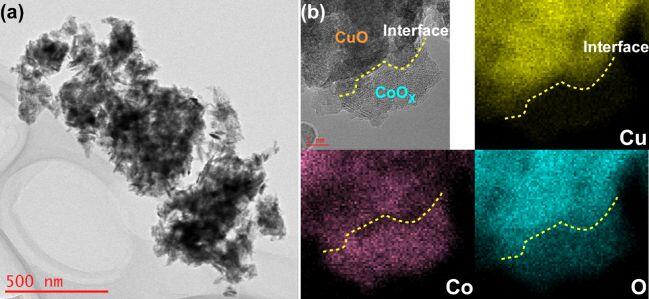
Figure 1
Electron microscopy images of the Cu-Co heterostructured catalyst. Crystalline CuO nanoparticles are interfaced with amorphous cobalt oxide, forming the heterostructure responsible for adaptive catalytic reconstruction.
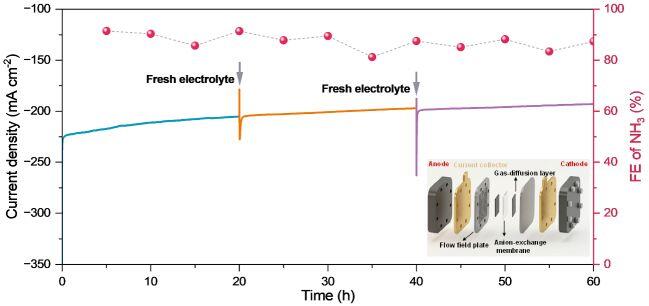
Figure 2
Continuous flow-cell electrolysis demonstrates stable nitrate-to-ammonia conversion for more than 60 hours, highlighting the catalyst's durability under practical operating conditions.
This work was supported by the Cooperative Research Program of the Center for Cooperative Research and Development of Advanced Materials, Institute for Materials Research, Tohoku University (Proposal No. 202512-CRKEQ-0012), and the PSI (Peace & Science Innovation Ecosystem) GAP Fund (PSI2025_S1C52).
Comment
Ms. Chunyu YUAN (third-year Ph.D. student)
This work would not have been possible without the unwavering guidance, constant encouragement, and wholehearted support of Professor Takeshi Fujita, to whom I am sincerely grateful. I would also like to thank all of my collaborators for their valuable contributions, as well as the reviewers for their helpful comments during the review process. Although there are still aspects of this work that warrant further investigation, this study provides a solid foundation for future research. Moving forward, I will focus on the development of more efficient electrocatalysts and a deeper understanding of their dynamic structural evolution and catalytic behavior under operating condition
Prof. Akitaka ITO
The electrochemical nitrate reduction reaction was achieved through the dynamic adaptation of the catalyst during operation. The fascinating ability enabled continuous evolution of ammonia, which is one of the most important chemicals supporting the human activity. As the development of sustainable production method to alternate with the Haber-Bosch process has attracted significant attention, we expect this technology contributes significantly to the future development of green ammonia production.
Prof. Takeshi FUJITA
Nitrate is an underutilized resource that is both a major water pollutant and a potential feedstock for ammonia production. In this study, we developed a new catalyst that converts nitrate into a valuable resource. We believe that our discovery--that the catalyst dynamically evolves into its most active state through adaptive catalyst reconstruction during operation--represents a new catalyst design principle for electrocatalysis. We hope this technology will contribute to the practical realization of sustainable systems that simultaneously achieve water purification and resource recovery through green ammonia production.
Glossary
*1) Adaptive catalyst
A catalyst that changes its surface structure and chemical state in response to reaction conditions, dynamically evolving into its most active state during operation. In this study, the researchers demonstrated that the copper surface undergoes adaptive catalyst reconstruction, forming hydroxyl-rich Cu-OH active sites, which greatly enhance the conversion of nitrate into ammonia.
*2) Electrochemical nitrate reduction (NO₃RR: Nitrate Reduction Reaction)
An electrochemical reaction that uses electricity to reduce nitrate ions (NO₃⁻) into ammonia and other products. Because the reaction proceeds under ambient conditions (room temperature and atmospheric pressure), it can simultaneously remove nitrate contaminants from water and produce valuable green ammonia. It is attracting increasing attention as a next-generation technology for both water purification and green ammonia production.
*3) Green ammonia
Ammonia produced using electricity generated from renewable energy sources, with significantly lower carbon dioxide emissions than conventional production methods. It is attracting growing attention as a carbon-free energy carrier for a sustainable society.
*4) Hydrogen spillover
A phenomenon in which reactive hydrogen species generated on one material migrate to the surface of an adjacent material. In this study, reactive hydrogen generated on amorphous cobalt oxide migrates to the copper active sites through hydrogen spillover, thereby accelerating ammonia production.
*5) Amorphous structure
A structure in which atoms are arranged randomly rather than in the highly ordered pattern found in crystalline materials. Typical examples include glass and rubber. Because amorphous materials lack a regular crystal lattice, they expose a large number of catalytically active surface sites, resulting in higher chemical reactivity and catalytic activity than crystalline materials. In the present catalyst, the amorphous cobalt oxide exhibits excellent water dissociation activity, efficiently generating the reactive hydrogen species required for ammonia synthesis.
Publication
Title: Adaptive Cu Reconstruction in Heterostructure Drives High-Rate Nitrate-to-Ammonia Conversion
Authors: Chunyu Yuan, Saikat Bolar, Yongzheng Zhang, Akitaka Ito, Tatsuhiko Ohto, and Takeshi Fujita
Journal: Advanced Science
Publication Date: July 13, 2026
DOI: 10.1002/advs.76573
RELATED POST
関連記事