
- TOP
- Cutting-edge Research and Social Contribution
- Cutting-edge Research
- Development of a low-cost, ultra-sensitive optical fiber refractive index sensor

Development of a low-cost, ultra-sensitive optical fiber refractive index sensor
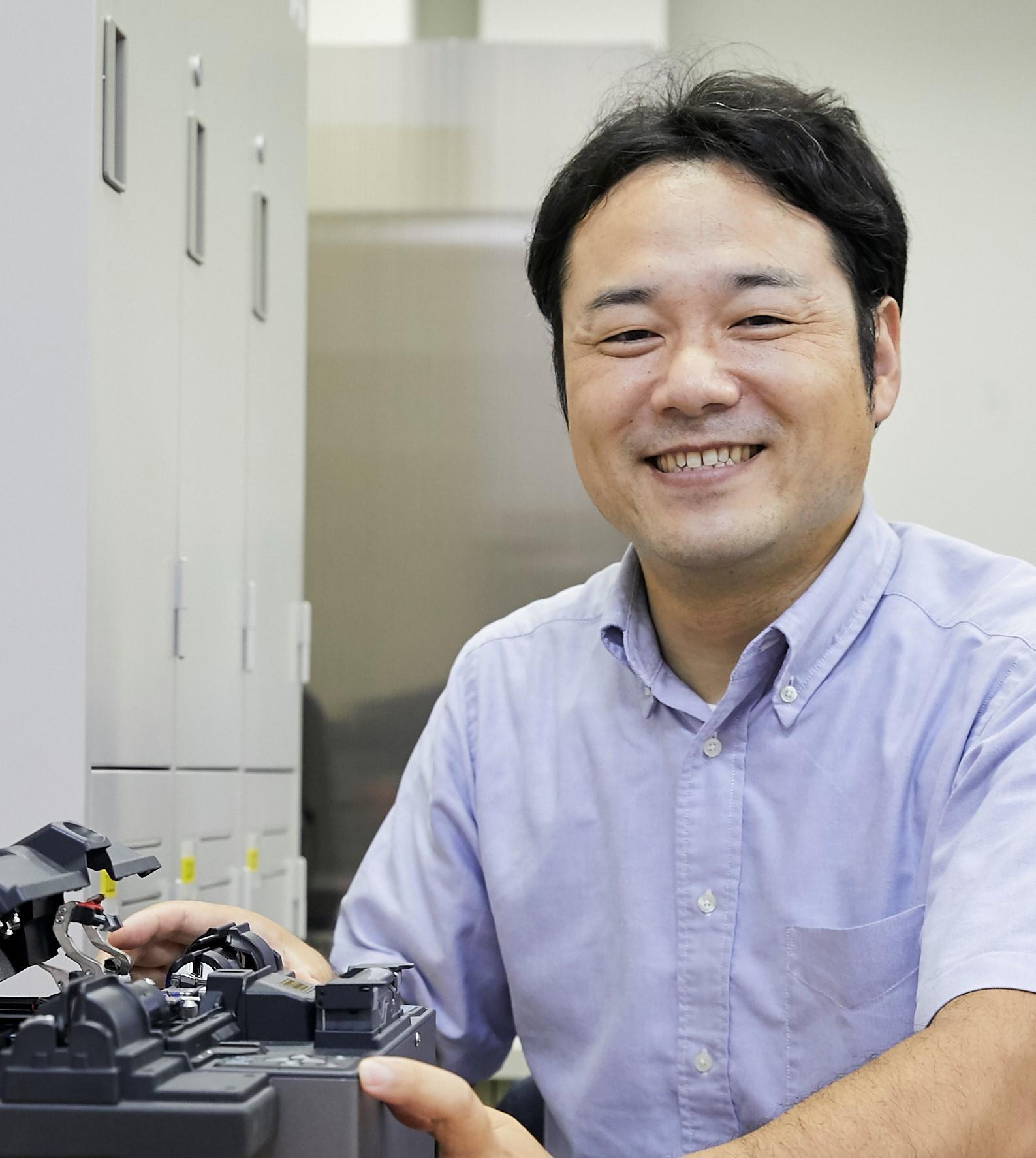
- From everyday products to cutting-edge science, optical technology is indispensable to modern society. Associate Professor Shuji TAUE, an expert in applied optical engineering, has been conducting research and development on optical measurement technologies that utilize the properties of light and its interaction with matter, aiming for applications across multiple fields including industry, biotechnology, and medicine. One such development is a sensor that uses optical fiber to measure solution concentration from changes in the solution's refractive index. "Ultrasensitive measurement becomes possible by utilizing light interference that occurs within the optical fiber," he explains. Associate Professor Taue and his team succeeded in achieving high sensitivity--a problem with conventional technology--through an extremely simple structure. This was done by utilizing an optical fiber sensor employing a "multimode interference structure" that can measure the refractive index simply by fusing commercially available telecommunications optical fiber.
Achieving high sensitivity through simple structure by using a multimode interference structure
Technology for managing the concentration of aqueous solutions, including saline solutions, is essential across many fields, including industry, medicine, and food, and the sensors used need to have high precision. Almost all such measurements employ electrical conductivity meters, but these require immersing electrodes in the solution, leading to problems such as elution of electrode components and electrode corrosion. There are high expectations for development of methods that can measure solution concentration at high precision without using electrodes, and attention has turned to techniques that measure concentration based on the refractive index of solutions measured using light. Sensors using this method have already been put into practical use, but achieving high sensitivity requires precise optical systems, resulting in issues such as larger sensor size and higher cost. To address this, Associate Professor Taue and his team have developed a new sensor using optical fiber with excellent corrosion resistance and they have been advancing research toward making it highly sensitive.
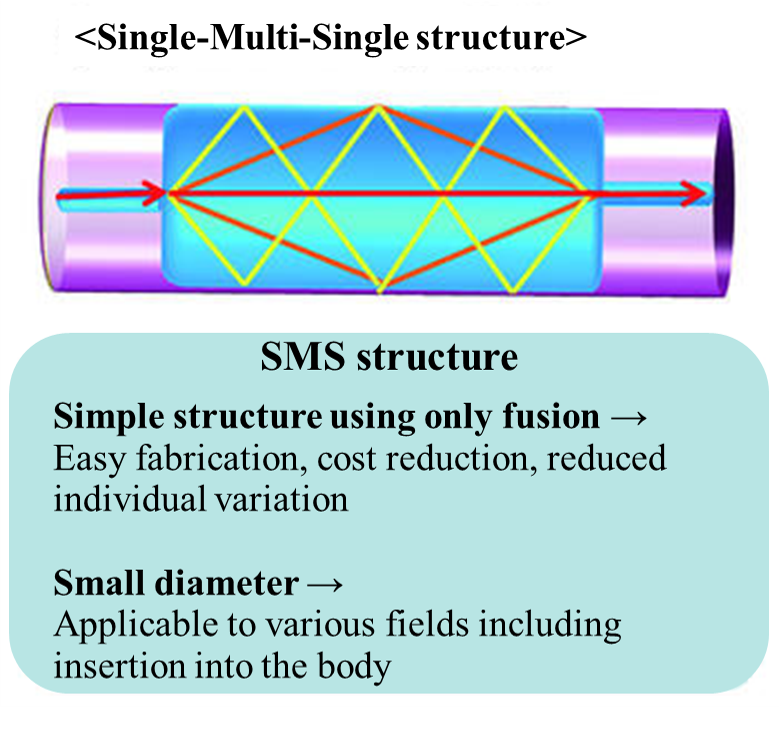
Associate Professor Taue explains the developed sensor: "The key is to skillfully utilize the interference that occurs within the optical fiber without using complex optical systems." Here he employs an optical fiber sensor with a multimode interference structure. While single-mode fiber (SMF) has a small core diameter and transmits only one spatial mode, multimode fiber (MMF) has a large core diameter and can transmit multiple spatial modes mixed together. Therefore, within MMF, multiple modes advance while interfering with each other, and at certain locations the light couples, producing an image identical to the input light wave. The large interference signal obtained at this light coupling point is the key to achieving high sensitivity.
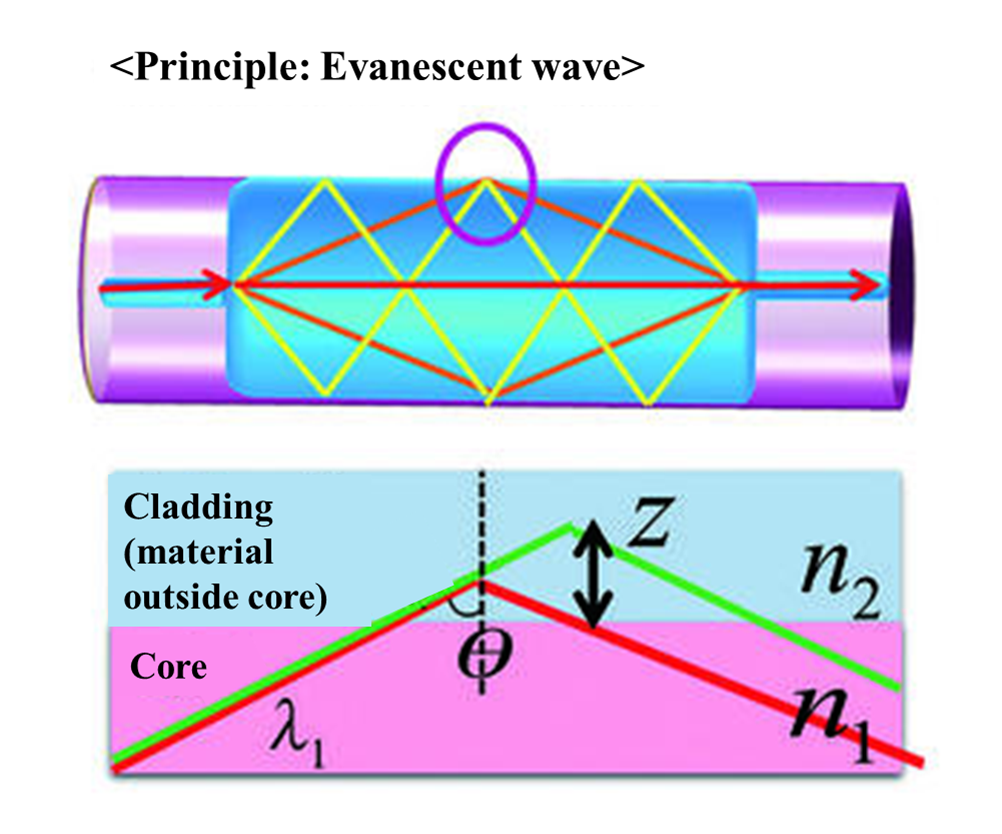
So how is the change in refractive index of the external solution measured? Optical fiber has a two-layer structure consisting of a core at the center and cladding surrounding it, and when light advances through total reflection within the core, a light component that leaks out slightly from the boundary surface is produced. This is called evanescent light. Evanescent light makes it possible to carry information on factors such as absorption and scattering caused by the solution near the boundary surface on the reflected light, and when the external solution changes, the leakage depth of the evanescent light also changes. For this reason, refractive index sensors employing optical fiber have utilized the interaction between the solution and evanescent light. However, the mainstream approach for utilizing evanescent light has been to remove the cladding layer up to a point near the core, and because this processing is difficult, widespread practical implementation has not been achieved.
Associate Professor Taue and his team devised an "SMS structure" that sandwiches a cladding-free MMF between SMFs at both ends as a structure that enables interaction with external substances through evanescent light. They constructed an "optical interferometer" that can coaxially utilize both the evanescent light outside the MMF and the mode dispersion inside.
Optical technology has a wide range of applications. Prof. Taue wants to pursue those possibilities
Through experiments using this sensor, Associate Professor Taue and his group have revealed the potential for application to concentration measurement in ethanol solutions and sodium chloride aqueous solutions. They have also shown the possibility of achieving world-class measurement sensitivity on the order of 10⁻⁶ by devising the type of optical fiber used. "Extremely high-sensitivity refractive index measurement may become achievable with just a single optical fiber," he says with anticipation.
Using commercially available telecommunications optical fiber offers many advantages, including: significant manufacturing cost reduction, installation within microchannels utilizing the ultrathin shape, and enabling remote monitoring. However, in actual measurements, output fluctuates due to noise from the devices and environment used, solution flow, and temperature, so constructing a robust sensor system that can respond to minute environmental changes remains a challenge. To solve this, Associate Professor Taue is bringing together the technologies and know-how he has acquired thus far, including optical fiber flow channel design and glass tube processing.
For industrial applications, he naturally envisions applying his approach to liquid manufacturing processes for foods such as beverages and seasonings, but he also has biotechnology applications in view and is planning expansion into areas like detection of proteins (antigens) in blood and bodily fluids. Systems that immobilize proteins such as antibodies and antigens on substrate surfaces and utilize the specific reactions possessed by biomolecules are known as sensing systems that enable selective and highly sensitive detection. Related to this, he has also begun collaborative research with other universities aimed at achieving ultra-high sensitivity in selective detection of measurement molecules by combining the sensor with a special light source called an optical frequency comb. Beyond this, applications are expanding into multiple fields, including monitoring of concentration of dialysate used in dialysis, and use in electrophoresis, a method for separating and analyzing biomolecules such as DNA and proteins. This broad range of application speaks to the high potential of optical technology.
"The sensor is almost completed, so I think it's now a matter of how to connect it to applications. The application range of light is broad, and needs may be lurking in unexpected places. I want to focus my efforts on discovering such hidden needs."
Date of posting: February, 2026